


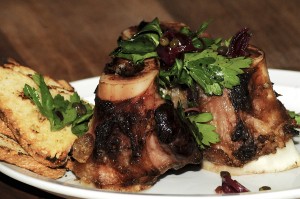
Black Market is a restaurant dedicated to the
nose-to-tail movement. Photo by Mark Lee.
Paradoxes and contradictions abound in the business of sustainability, and nowhere is this more evident than in the restaurant industry.
In the relatively new field of green living, restaurants have been some of the slowest entities to embrace the movement, in no small part perhaps
because they have to deal every day with us, the public; and we, the public are notoriously reluctant to accept change when it comes to what we put in our mouths and how what we put in our mouths is treated and prepared.
Historically, restaurant kitchens have been hot and noisy places with questionable waste disposal practices, zero to little recycling and
phenomenal levels of garbage, all in the name of either getting a perfect product to a demanding customer or getting a mediocre product to the
customer faster and cheaper, depending on the type of restaurant.
In this context, the first paradox worth mentioning is that many of the improvements made towards greening the restaurant business have come from the least likely source: the fast food chains. Regardless of whether this drive towards greening has been spurred on by public relations or by a genuine concern for the environment, there can be no doubt that progress over the past decade by a major burger chain to not only use post-consumer packaging instead of Styrofoam and to improve the living conditions of its chickens should be greeted with open arms.
The reluctance of many independent restaurants to adopt a similar approach is often attributed to expense, but I’m sure that most responsible consumers would be more than happy to spend an extra fifty cents for the knowledge that we aren’t destroying the environment every time we order take-away.
Enter the nose-to-tail movement
Many of the finest steak restaurants offer only filet, sirloin and rib-eye steaks. They might also mention that these animals are raised humanely on pastures, and are fed no hormones or antibiotics.
What they don’t mention is where the rest of the animal went after we took the “good” bits.
Where, for instance, are the tongue, the liver, the heart, kidneys and shins? Not to mention the tail and the intestines. Or the stomach lining. So here’s another paradox: we care about how the animal is treated during its life, but we don’t care about what happens to it upon its death, or where the bits that we don’t deem for consumption actually go.
Is it to pet food, to fertilizer? I don’t know, but if restaurants were to put more of these bits on my table, I would definitely eat them.
Established (quite unwittingly I imagine) in the early ‘90s by a London restaurateur by the name of Fergus Henderson, the food-to-tail movement was an attempt to pay full respect to every animal that we kill for food. Henderson’s highly regarded restaurant, St. John, might offer on a typical menu some of the following: lamb hearts, pig spleens, pig ears, tripe, trotters or kidneys. In fact, all the good stuff which we are missing when we insist on living high off the hog.
Some may think that it’s a fad to eat this kind of food. I consider it to be our duty.
Although nose-to tail has been a bit slow to get to these parts, it is arriving, and things are looking up for the omnivore. Restaurants like Recess, Black Market, Late Harvest Kitchen and The Libertine are happily dishing up the bits most of us wouldn’t have eaten a decade ago.
Furthermore, a huge number of establishments are using locally sourced, often organic, ingredients from a growing number of homestead farms.
Time for another paradox. When I first moved to Indiana, there existed what was known as the fifty mile rule, an unstated law which determined that if any product originated closer than fifty miles from the restaurant, it couldn’t be any good. Exotic was better, and the further away it originated, the better.
I remember a cheese producer from southern Indiana telling me that she couldn’t give away her goats’ cheese to upscale restaurants in Indianapolis, yet they were doing well in New York. Now we can’t get enough of it.
Running a green, sustainable restaurant is about so much more than putting responsibly farmed meat, organic vegetables and certified seafood on the table. It’s also about how to use surplus ingredients, address the issue of over-sized portions, reduce food miles and aim for carbon neutrality.
All in all, a pretty tall order. We’ll be addressing these and other food-related concerns in forthcoming issues. Meanwhile, read on to find out more about ten Indiana restaurants who are making a difference.
For more restaurant sustainability stories click here.
