



It seems the grass needs to be green in Westfield, Indiana, where “Keeping up with the Joneses” requires a conventional approach to the landscape. Green lawn often trumps green living, despite the environmental and monetary burden [see sidebar]. Lurking under the blades of grass is a riptide of consequence that not only carries the voiceless concerns of the ecosystem, but also the plight of Gloria J. Cassady.
In 2011, Cassady sat among 1,200 patrons in the Clowes Memorial Hall at Butler University to hear the words of conservationist author Dr. Douglas Tallamy. Professor and Chair of Entomology and Wildlife Ecology at Delaware University, Tallamy penned the 2009 title Bringing Nature Home, an informative text regarding ecologically sustainable landscapes in suburban environments. [see below for more on Tallamy]
“I saw Doug when he spoke at Butler,” Cassady recalls. “He was so eloquent and so persuasive. I picked up the book and thought, there are so many things in the world that I can’t affect, maybe I can do something with my little corner of it.”
Cassady had done so earlier in her life. Native to Winchester, Indiana, she left the state following college at Ball State University to pursue the arts in California. While in San Diego, she transformed her property into a self-proclaimed haven. “I was only 15 minutes from downtown but I had almost an acre,” she says. “My little cottage tripled in value in ten years. My yard was a destination, and people appreciated it. I really expected the same here.”
Returning after a thirty-year hiatus, she purchased a home in Westfield in a subdivision called Beacon Pointe. Following her encounter with Dr. Tallamy, Cassady began drafting plans on the transformation of her half acre plot in Westfield from traditional landscaping styles to one incorporating native plants and progressive themes. “I’m just happy when I see more of nature,” she says. “I knew what I wanted conceptually. I knew that I wanted density, contrast in shapes and textures and visual interest.”
To hear her speak of her intentions, the plan seemed more akin to a meditation garden than simply an eco-friendly twist on the norm. “When I would look out my windows I would see green,” she says. “Transition gardens with lilies… Top dressed with bark chips. I would have trees, shrubs…a path that would be like a dry river stream with stepping stones in it. I would have a place to have tea in the morning. It would be inviting to everyone. My inspiration was to be surrounded by green and to contribute positively to the environment.”
But instead of a sustainable landscape, Cassady’s plan created community scrutiny, citations, legislative amendments — and a lawsuit with the homeowner’s association.
Social ire
As Cassady initiated her yard’s transformation on May 7, Beacon Pointe HOA president Mark Jordan demanded a moratorium. “[Mark] came charging down, demanding I stop and not plant even a single solitary flower until I submitted a detailed landscape plan for my entire property and ask for his architecture design committee’s approval,” Cassady recalls. “I said that there’s nothing in the HOA docs that require this, I read them before I bought the property. I asked if he could tell me a precedent.”
According to Cassady, Mr. Jordan replied that there was no precedent, and that the HOA documents were “vague.”
Editor’s note: Beacon Pointe HOA refused to comment for this article due to pending litigation against Cassady.
Cassady explains, “My understanding of the law is that if I chose to use their form and submit, asking their permission, I’m giving them rights that their own HOA documents do not give them, and am setting new precedents for the entire community. That’s inappropriate. My reasoning is that when someone is bullying you, you don’t hand them a bigger club.
“The day after that, I went over to the vice president Chris William’s house and he told me to hire a lawyer and to not get him involved,” she continues. “I thought that was curious. I wrote an email to the president and copied the whole board on it. I basically just said that anytime I can be a part of the dialogue, I’d be happy to share the details with anyone who wants to see them, but I’m not asking for permission.”
Undaunted, Cassady reached out to the city’s planning commission for approval and a formal place to begin. It appears as though her reputation had 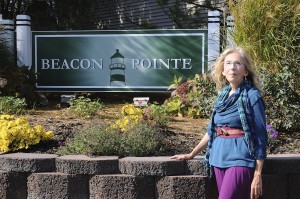 preceded her. Conversations with bordering neighbors and Beacon Pointe HOA regarding her plan seemingly had stirred the pot, as the city began receiving complaints prior to the initiation of her plans.
“I called the city and asked who I should talk to about plans to improve biodiversity,” she says. Kevin Todd is a senior planner for the city of Westfield on the technical advisory committee. According to Ms. Cassady, he was initially receptive to the ideas outlined in her plans. “I asked Kevin if he saw any problems with [my ideas], he said no, that sounds great,” she recalls.
Mr. Todd scheduled a time to meet with Cassady the following day, asking for permission to photograph her property and get a better idea of her intentions.
Upon arrival at her home, however, optimism had apparently faded. “When he got here, he was kind of vague, talking more about the complaints,” Cassady recalls. According to her, Mr. Todd mentioned neighbors by name, declaring that he was hesitant of her project out of fear of losing his job.
Editor’s note: Mr. Todd did not reply when asked for comment on this story.
In her search to improve her plot’s biodiversity, Cassady had become aware of section 14 of Westfield’s “Tall Weed Ordinance 12-20.” Initially drafted as a provision to prohibit properties from becoming overgrown, the Tall Weed Ordinance stipulated that all “weed or rank vegetation” growths in any residential property only reach an average maximum height of 12 inches.
Section 14 of the ordinance claims that any property that meets the approval of the Director of Community Development may qualify as a Natural Habitat, or in other words, an area exempt of typical vegetation jurisdiction for the means of accomplishing greater ecological goals.
Seeing the value of Section 14 to accomplish her goals, Cassady pressed Mr. Todd for further information regarding converting her property into an ecological habitat. Despite his hesitation of further aggravation among neighbors, Mr. Todd proposed that Cassady submit an application to Community Director and City Council member Matt Skelton.
Cassady applied for the permit as suggested by Mr. Todd. While out of the state in mid June, she was informed via email that her request had been approved by Director of Community Development and City Council member Matt Skelton and signed by Mr. Todd.
However, with progress having halted due to HOA intervention, by her return weeks later, her yard had become unkempt. Her grassy areas had achieved a height of roughly three feet tall, helping to solidify the opinions of those opposed to her attempts.
Westfield steps in
Days later, she received a citation via certified mail due to the state of her property. “I had told the HOA and the city that I had plans to be out of town,” she says. “I wrote Kevin and said that I didn’t want anything to happen in my absence.” According to correspondence received by Ms. Cassady’s realtor who helped her purchase her home, during her absence the city sent an inspector to her property to check for violations against the tall weed ordinance. “I got a terse email from Kevin saying that he had issued a citation for what they said was Canada Thistle.” [The citation was eventually dropped.]
As the citation was issued, pressure began to rise. Within days of the citation being sent, Matt Skelton, Director of Community Development and the original issuer of Ms. Cassady’s Natural Habitat permit, proposed drastic changes to the Tall Weed Ordinance. On June 25, Westfield’s city council met to discuss the amendment of section 14 of the ordinance, removing the ability for natural habitats to exist in properties built after 1977.
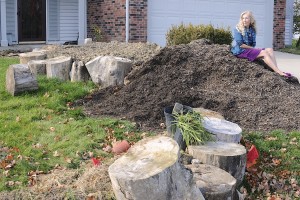 Cassady’s home in Beacon Pointe was constructed in 1989. Missing the cutoff date to be grandfathered into the ordinance, Cassady’s property would now be unable to qualify for her previously issued permit.
On the same day that the ordinance change was first proposed by Mr. Skelton, Beacon Pointe HOA formally filed a lawsuit against Cassady, attempting to legally force her into compliance with neighborhood standards regarding landscape.
Editor’s note: Matt Skelton deferred comment on this story to Westfield’s Office of Communications, but those communications directed the writer to another contact who never responded to his queries.
Following the initial council meeting, council member Steve Hoover formed a committee to look into the ecological ramifications of the proposed changes. The group was hopeful of creating a more informed vote through interaction with local experts.
Two weeks later, with no public forum, the city council called the Section 14 amendment to a vote. The ballot came so quickly on the heels of the amendment’s proposal that Mr. Hoover’s team didn’t have the opportunity to gather any further information. Mr. Hoover asked that the council delay the vote, and according to Cassady, who was in attendance, said “I see no urgency in this matter, and we haven’t met yet. I really think that our committee … might want to make additional changes.” The council proceeded despite Mr. Hoover’s appeal.
The proposed changes passed, with Mr. Hoover voting in favor of the amendment. The only nay vote came from Councilman Robert Stokes, voting against the motion for the sake of wanting more information regarding the proposal’s impact.
Available for interview, Mr. Stokes submitted that Cassady’s circumstance was in fact the force behind the change in legislation. “Her situation definitely pushed it to the point where we needed to do something,” he says. He believes, however, that the new change in the ordinance was not due to nepotism towards other Beacon Pointe residents, but rather due to the extreme circumstance of Ms. Cassady’s property. “It’s good to have the ecology aspect in mind, that’s a good thing,” he says. “But she also has to take into account that she lives in a platted subdivision. Her plan looks great. Progress just wasn’t there. That’s how we got to where we are.” Despite his dissenting vote, Mr. Stokes believes that additional input from local ecological groups wouldn’t have changed the vote’s outcome.
John South, engineer and district manager for Hamilton County Soil and Water Conservation was in attendance at the first meeting introducing the amendment. He believes that the amendment leaves too much room for interpretation. “The concerns that I have against the ordinance specifically…is the wording,” he says. “Unfortunately by the definition I suppose ‘grass’ can be a rank vegetation because it grows vigorously. The problem is that a lot of our native vegetation commonly grows taller than 12” but is very beneficial. The definitions leave a lot of area for interpretation.”
South also feels as though the process occurred uncommonly fast. “It did happen fairly quickly,” he says. “I was surprised that they could and would revise an ordinance without any kind of a public hearing. I thought that was a little unusual. This one probably occurred quicker than most.”
The passing of the Natural Habitat amendment removes the legal safeguard for Cassady’s plan, putting her conflict directly with the HOA.
She claims her progress was stalled not due to a fault in her plan, but rather to impediments by the lawsuit of the HOA and the city of Westfield. “My yard is in its current condition because I’m not able to plant anything,” she says. “No one is more daunted than me. My number one priority is I have to respond to this bogus litigation against me. That overshadows everything. I have this shadow looming over me. I’m 65, retired and living on Social Security. I’ve invested everything in this property.”
Due to the ecological nature of the lawsuit and Ms. Cassady’s personal circumstance, she says that a local law firm has been willing to take on her case for limited cost. As of this fall, she was optimistic about the direction that legal talks were proceeding. “I had a meeting with Mark and [his] attorneys yesterday,” she said via email. “My attorney petitioned for another 30-day extension of time to work out, as our first draft was not ‘agreement exemplifying and assuring equitable treatment.’ So nothing’s signed yet, and the devil may be in the details, but they are verbally agreeing to pull the litigation and to schedule an informative meeting about ecosystem and beneficial landscape practices inviting all Beacon Pointe residents, and to allow my improvements to move forward as availability (plants / contractors / etc.) permits.”
Sitting in the sun in her backyard, Gloria Cassady is still determined. “Here now, hearing the birds, I’m energized by it. I haven’t changed, much to many people’s dismay. I don’t have time to plant a tree at a time. Our environment can’t stand for people to plant a tree at a time. I didn’t go into this thinking this will be an example, I was thinking that this was something that would nurture my spirit and nurture the environment, and other people would appreciate it.”
She turns and looks out at the yard that has yet to become her dream. “If you keep putting good out in the world,” she says, “something good has to come back to you eventually.”
So… why do lawns suck?
-
Americans buy 70 million pounds of chemical fertilizers every year (EPA)
-
Americans spend around $6.4 billion on lawns every year (Lawn Institute)
-
Turf grass takes up nearly 32 million acres of the U.S., making it the nation’s largest irrigated crop
-
50 to 70 percent of residential water is used for landscaping
-
10,000 gallons of water is spent on average each summer on 1,000 square feet of lawn
-
Equipment for lawn maintenance burns fossil fuels and costs add up
-
Grass grows best and becomes the most durable when many varieties are grown together
-
Natural habitats help water retention
-
Natural habitats keep nutrients in the soil instead of eroding
-
If you aren’t using pesticides, earthworms can help keep soil healthy
-
Well-maintained, natural landscapes act as carbon sinks
More on Doug Tallamy
Dr. Doug Tallamy believes progressive plans like Gloria Cassady’s can have profound influence on suburban areas. “Humans have developed landscapes for their own use that are very poor habitats for anything else. I’m trying to suggest that it doesn’t have to be that way,” he says. “We can actually have landscapes that are useful for us, are beautiful for us, but are also functional for other things.”
Professor Tallamy likes to use birds as his prime example of facilitating nature in suburban environments. “Everybody likes birds,” he says. “There are 32 million people in the US that feed the birds every winter. 96% of birds when they’re rearing their young are feeding them insects. Those insects that they’re feeding them are being made by plants. The plants that are best at making them are [native]. If you bring plants from Asia, and 79% of our ornamentals are from Asia, they’re very poor at supporting food. The themes in my book are consistent across the whole planet.”
Those interested in bringing nature to their own backyards, they should start by planting trees. “Woody plants are more productive in terms of the number of insects that they support than say perennials and annuals,” he says. “Those are still important, but for example the most valuable plant that we have…are Oaks. We’ve shown that they support 534 species of caterpillars, so that’s 534 species of bird food. Which plant you’re going to put in there is going to determine how full you’re filling your bird feeder. That’s how I look at it.”
Despite his passion for infusing sustainable practices into everyday environments, Tallamy understands the social dangers associated with making such changes. “I don’t think we’re ever going to achieve what I want to achieve by going forcibly going against what’s considered socially acceptable,” he says. “Because then you’ve got people who are going to fight change. I want people to recognize the benefits that this type of landscaping is bringing them. I want it to be done carefully, I want it to be done in a way that everyone in the neighborhood drives by and says, ‘I want that.’ We’re making progress, I think landscape designers have to play a bigger role in trying to achieve the goal of more…native plants in your landscape without making it look like you’ve just moved out and forgot to mow the lawn. People are just going to rebel against that and it just sets the whole movement back.”
More information on Dr. Tallamy and his book, Bringing Nature Home, can be found online at http://www.plantanative.org/