


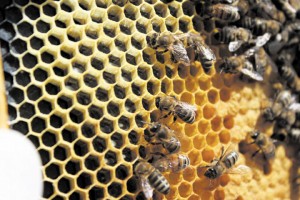
Photo by Will McCarty
Ross Harding pulled thousands of bees out of a bedroom ceiling this year. Their new digs? The R Bistro garden, just off the Cultural Trail.
“It’s really nice to take bees from somewhere like that –– where someone might kill them –– and save them and relocate them to a place like [R Bistro],” Harding said.
That hive now houses more than 60,000 bees, who, by day, are constantly coming and going between the flowering trees, lavender bushes and various plants that populate the garden. At night, they fan their wings furiously, drying out the nectar they’ve collected and turning it into honey.
Harding, 27, has been beekeeping for almost two years. His interest was sparked by an article covering the basics in Backwoodsman magazine.
“I got into it for honey,” Harding said. “But then I built a huge appreciation for the honeybee, especially [after reading about] the decline of the population.”
Now, he’s part of the core group of the Central Indiana Beekeepers Association, where he presents monthly Bees in the News information sessions, keeping the group up to date on the latest threats to bees. He also teaches regular bee education courses.
“A lot of people are afraid of bees,” said Harding, who works full time at a local communications company and bee-keeps in his free time. “Knowing that they’re not out to get us, that they do good for our environment, that we need them for food, that’s what’s most important.”
Earlier this summer, Harding conducted a basic beekeeping course for the employees of R Bistro, who got to peer into the two hives that sit just outside the kitchen of their Mass Ave restaurant.
As he pulled the frames out of the top bar hive one by one, he talked casually about the structure of the hive –– guard bees, nurse bees and hive cleaners scurried over the panels.
Then, on frame four, something special.
“I can see the queen from here,” Harding said excitedly, as he eased the frame from its slot.
The wax covered frame teemed with hundreds of bees –– and there, right in the center, the queen. Queens are much bigger than other bees and are slightly lighter in color than the drones and workers. As we watched, she buzzed from cell to cell over the honey comb, dropping eggs into each cup. Over the course of one day, a queen can lay more than 2,000 eggs –– more than her body weight. While regular workers (sterile females) and drones (males) live approximately 45 days (“They essentially flap their wings off,” said Harding), a queen can live up to six years.
Right now, he stops by the R Bistro hives about once a week. It’s not ready for honey harvesting yet –– each hive needs between 80 to 100 pounds of honey to make it through the winter – so it’s fairly low-maintenance for now.
“Once I know that they’re set up with a laying queen, I don’t have to worry about them too much. I make sure they have enough space; if they don’t have enough space, they can swarm.”
But Harding is experienced with swarms. In fact, his now- hived swarm at R Bistro is currently one of his healthiest colonies.
Harding’s goal for the end of summer is to place 10 total hives. He’s planning for hives on top of Ivy Tech as part of the Culinary Arts Program. There, he plans to conduct beekeeping skills classes and demonstrate honey harvesting techniques.
He’ll also remove swarms from houses, trees and other structures when requested – where there’s wild swam, Harding will be there.