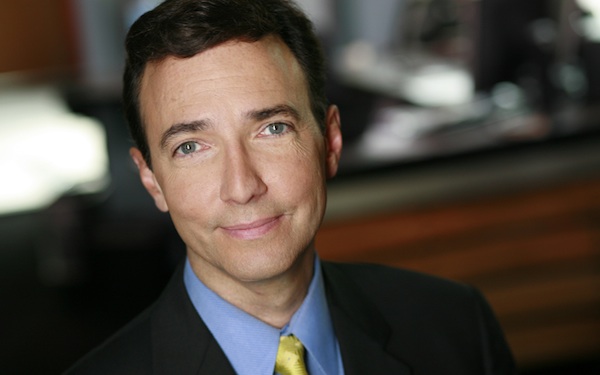
Paul Douglas
Republican and evangelical Christian broadcast meteorologist Paul Douglas is in town this week, continuing his mission to communicate the urgency of climate change. He does so in a variety of surprising ways, talking about global warming as part of his profession as a broadcast meteorologist, and trying to inspire his fellow Republicans to acknowledge the reality of climate change.
I spoke with Douglas by phone a handful of weeks ago, and published a long interview in NUVO. Here are the highlights of that conversation.
Poyser: When did you begin to take note of climate change?
Douglas: All of us have different thresholds for when you acknowledge the science. For me it was when James Hansen went before Congress in 1988. I thought he was jumping the gun. I didn’t see it. But after living the weather … and that’s what any meteorologist does: you live the weather … I just noticed in the mid and late ’90s that something had changed.
Poyser: How so?
Douglas: It was no longer my grandfather’s weather. The rain was falling with greater ferocity. We were seeing more extremes with greater frequency and greater intensity than I had ever witnessed in my career. So I started digging into the peer-reviewed science and basically came to the conclusion that climate scientists were probably right, that there’s just too much evidence.
I don’t take the environment for granted. We are a part of nature. I don’t see anywhere in the Bible where it says that we’re supposed to dominate nature.
The book of Luke says, “We are stewards and we will be accountable for our stewardship.” I take that seriously. When I talk to my friends on both sides of the aisle politically I say, “We’re accountable. You should care about this. If you care about your kids and your grandkids, as our parents cared for us, this is not only a scientific issue, it’s a moral issue and an ethical issue.”
There is something fundamentally immoral about kicking the can down the road and saying, “Well, not enough data and maybe it’s real but our kids and our grandkids can clean up our mess.”
Our kids are going to be pissed and I want to be able to look my kids in the eye and say, “You know what? Your old man did everything that he could to beat the drum and to let others know that this is real.”
We ignore the science at our long-term peril.
Poyser: When did you begin to actually talk about climate change as part of your job as a broadcast meteorologist?
Douglas: In the late ’90s I began including it in my weather statements. Every day I would get scores of emails like, “Flaming liberal. You crazy crackpot. Why are you buying into this Al Gore conspiracy? You’re going to cripple our economy.”
It is the equivalent of sticking your finger in the electrical socket. Most of us are conditioned to avoid pain, to avoid controversy. Everybody on television wants to be loved and your contract — whether you’re renewed — really depends on your ability to attract an audience. Just by reporting on this you know that you’re alienating people with a certain ideology.
Poyser: Yet you persisted in talking about climate change.
Douglas: I persisted and I continue to persist because the subject is too important. I thought it was ludicrous that this was somehow a litmus test for conservatism. I remind my Republican friends that Teddy Roosevelt, staunch Republican, founded the National Parks Service. Richard Nixon, say what you will about Dick Nixon, and I’m not a huge Nixon fan, but he started the EPA. There is a history of environmental respect, respect for the environment.
I’m not saying we don’t take advantage of our natural resources. The message I’m trying to get out is that by fixating exclusively on fossil fuels, not only are we endangering future generations, we are endangering our competitiveness down the road.
This is a chance to reinvent and retool America, wean ourselves off foreign oil. Mitigating climate change is going to require a level of innovation and reinvention that will propel us to a new competitive paradigm. By focusing on carbon neutral ways of generating energy and growing our GDP, we will take American exceptionalism on the world stage to a new level.
Poyser: I like to think we’re at a turning point: the thirst for knowledge about what is happening to the climate is growing.
Douglas: It’s ironic that extreme weather has accomplished what the climate scientists up until now could not. And that is convince a majority of logical, God-fearing Americans that something has changed. [According to a Yale University poll], four out of five people last year were personally impacted by extreme weather. … One out of three were physically injured by severe weather last year.
This weather-on-steroids environment is getting people to wake up. I keep telling people that trillions of dollars are in play. Fossil fuel companies are scared to death that they’re going to be regulated out of existence or that there will be regulations that they can’t drill and mine, and that will affect their share price, their stock price, and their ultimate company value.
Although you can’t prove direct causation with [Superstorm] Sandy, in my humble opinion — and that of most of the climate scientists I know — it’s a case of systematic causation. We’ve loaded dice in favor of more extreme storms, heat waves and drought. We’ve super-sized our weather … the timing, scale and scope of the storm were extraordinary – like nothing I’ve ever witnessed, a hybrid of hurricane and Nor’easter that is not very well understood.
Poyser: Are Republicans listening to you?
Douglas: What I am finding is that younger people, younger conservatives, younger evangelicals are listening. They respond to data. That’s one of the first things that I say when I go out and talk. I ask people, “Do you have an open mind? Or is your mind made up and you’re going to cherry-pick data to support your ideological beliefs?”
It’s OK to be conservative and still acknowledge the science and to recognize something that Jesus taught: Actions have consequences. You can’t release 90 trillion tons of greenhouse gases in 50 years according to the Department of Energy, 90 trillion hot air balloons of man-made pollution, and pretend that that’s not going to have any impact.
… Sometimes I wonder, you know, is our country ready for a third party? A green party or … I don’t know.
Poyser: How about the common sense party?
Douglas: I think you’re right. I still think most Americans are somewhere in the middle of the bell curve. Most Americans are fairly moderate. And yet our system has been hijacked by extremists at both ends of the political spectrum. It just makes me nuts that Washington does not reflect what’s happening outside of the Beltway, scientifically or otherwise. The naïve optimist in me believes that this will be corrected over time.
Yet the amount of money in play right now is staggering and I do worry about what that means for representative democracy. It’s too easy to listen to Rush Limbaugh on the radio or to look at a blog post someone emailed you.
People need to educate themselves and not rely on what Uncle Joe says at the dinner table. There’s so much information available online, but you need to be looking at peer-reviewed science. Not somebody’s opinion in a blog post. Not what you heard on the local bloviating talk show in town. The data is the data and people need to be seeking out science. Not opinion.
Paul Douglas’ blog: http://www.startribune.com/weather/blogs/paul_douglas_on_weather.html?vi_adid=W
INFOBOX:
Fifth Annual Greening the Statehouse Forum
Hoosier Environmental Council
Saturday, Dec. 1, 8:30 a.m. - 3:30 p.m.
University of Indianapolis
1400 E. Hanna Ave.
Tickets: $10 students; $20 general; includes lunch
For more: hecweb.org
Information tables abound at events like these. One brand new group, the Climate Advocacy Network, was actually first discovered by Indiana Living Green. WeCAN founder Amanda Shepherd discovered the lack of a climate action plan in Indiana, and alerted ILG Editor Jim Poyser and ILG writer Wendy Bredhold. The story by Bredhold about Indiana’s lack of a plan to address climate change appears in the November issue — and a follow up story in the December issue. Shepherd will be on hand to discuss her new organization, and what it hopes to accomplish.