Spring, the season where city dwellers of all sorts begin anticipating the return of all things green, is just around the corner. For animals in the city, this means a new variety of plant tissues – fresh shoots! tender young leaves! flowers! – for consumption after the brown autumn and gray winter. For humans, it means planning this year’s garden, the slow drama of shade trees leafing out, and the return of a verdant lawn.
About those lawns: in terms of acreage, turf grass ranks as the number one irrigated crop in the US, and we rely on fertilizers to maximize the green of our lawns, not to mention the productivity of our gardens. Now consider that more than a third of homeowners in the U.S., most of whom live in urban and suburban areas where the majority of turf grass is grown, over-fertilize their lawns.
But what is good for the lawn isn’t good for the rest of urban ecosystems. Chemical fertilizers don’t always stay put, even when properly applied. They are picked up anytime water moves and end up wherever the water takes them. Too often this is in municipal water supplies and aquatic ecosystems where the abundance of nutrients can do for algae what they do for a lawn – encourage growth and make it green.
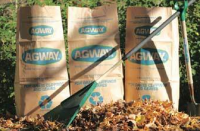
Leaves for collection in the fall.
There is no denying that we are overly reliant on chemical fertilizers in fostering plant growth within urban ecosystems. The great irony is that each autumn we are guilty of throwing away the very thing we end up paying for (in more ways than one) each spring.
On a Tuesday afternoon this past November, I counted 586 bags of leaves waiting for the Wednesday morning trash pickup along a stretch of 12 blocks in the Butler-Tarkington neighborhood. The next week, along the same stretch, another 500 bags of leaves were in their place. Some back of the napkin calculations give us this picture: on a single street in Indianapolis, over a distance of little more than a mile long, more than 16 tons of leaves were collected in a two week period.
And what is it that we are hauling away why we put our leaves curbside? A lot of carbon, to be sure, but also significant amounts of nitrogen, phosphorous and potassium, which is exactly what we are buying when we purchase chemical fertilizers. If the leaves that fall from our trees are broken up and allowed to decompose, the same nutrients pulled from the soil and incorporated into plant tissue will return to the soil where they can nourish our lawns. Decomposition is the ultimate in reusing and recycling.
By hauling away the raw material, we limit the urban ecosystem’s ability to reuse the raw materials. If leaves are composted each year instead of being shipped off, our lawns will be just as green and our city will be far greener still.