By Marissa Argus
We’ve been open just shy of two school years, but the work that has been accomplished at our school has been incredible. We built this school from
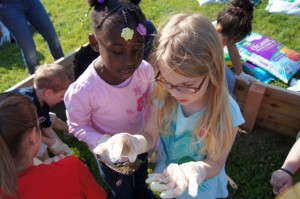
Students at IPS/Butler University Lab School work in their schoolyard garden.
the ground up with much support from Butler University and the trust of Indianapolis Public Schools that we would do great things — and we are.
Amongst the many things we have worked hard to create and sustain for our kids, one of our schools’ sources of pride is our garden space. We currently have 9 large cedar garden boxes, a beautiful outdoor classroom space with shed and pergola, a three tier composting system, an orchard in espalier style along our fence line, and three feisty Rhode Island Red chickens: Thelma, Louise and Caroline.
The entire school shares responsibility for the garden, including classes during the school day, families over long breaks, and even Miss Kelli, our beloved custodian, who goes out and talks with the chickens on a nightly basis.
All that we have accomplished on the northern side of our property didn’t happen in a day, however. It started with a simple comment from a student: “We should have a garden.”
Last spring, my kindergarten and first grade class was immersed in a mini project and we had been documenting acts of kindness. The kids were looking for ways to celebrate our successes together and one of my first grade students, David, shared his desire for a school garden. Immediately, the kids jumped on the idea and had responses to David like,
“We can grow healthy fruits and vegetables for lunch!”
and
“If we grow fruits, we can make a fruit salad!”
But there was one comment that really stuck out to the class. One of the smallest and youngest students in my class stood up and profoundly said,
“We can save some flowers and keep growing more and more. And people will come back for more and more. They will keep growing. When people have a wedding, we can give them flowers. We can keep giving.”
At this point, the kids were hooked. One child cheered, “It’s like a friendship garden!” and the idea was sold.
From there on, we studied worms (because one of my children brought in a worm from the alley and said, “I think this can help our 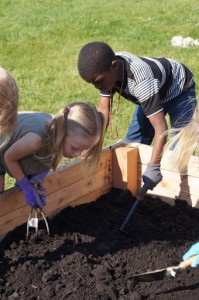 garden!”) and vermicomposting (indoor composting with worms). This led to a further insect study to see what animals would benefit our garden. We collaborated with Dr. Catherine Pangan, a professor from Butler University, who was teaching a leadership class that happened to be studying grant writing and fundraising. This collaboration allowed us to receive funding for our first three garden boxes, an indoor grow lab, and a variety of plants. At the end of the spring, about 20 college students, some parent volunteers and the 80 children from our school worked to toil, dig, fill and plant vegetables and herbs in our three beautiful boxes. Around the same time, we received our three hens from a donation from Just Pop In, a local popcorn shop.
This past fall, a large grant came through from Dow Agroscience which allowed us to add 6 more garden boxes, our outdoor shed, our compost system and our orchard. Having over 70 volunteers from Dow work next to our children in our outdoor space was incredible. I overheard a fantastic conversation between a scientist and a child about the organisms living under a rock in our garden. I know this wasn’t the only powerful conversation that inspired thinking that day.
The children have relished in noticing the connections between feeding the hens our garden scraps and using the chicken’s waste in our compost. The additional learning on living things, healthy eating, responsibility, care and sustainability has tremendously impacted our entire schools’ curriculum. The IPS/Butler University Lab School is a place where children’s dreams are not just heard: they are made into reality.