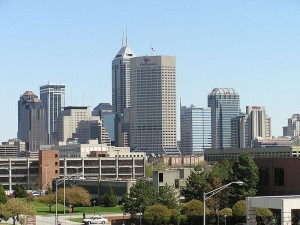
Photo Source: wikimedia commons
Indianapolis is one of the largest cities in the world without a commercial port nearby. The West Fork of the White River, too shallow for shipping, wasn’t a factor in the growth of the city. The founders of Indiana selected the site for its central location, as instructed by the state legislature. Because of the lack of river commerce, population growth was slow until the National Road (now U.S. Route 40) and rail lines arrived.
As a result, the river that winds through the city has long been an afterthought. Various attempts have been made to use it for economic gain, but for the most part it has simply provided an aesthetic backdrop. Unfortunately, like rivers everywhere, the people along its banks have also used it as a means of waste disposal.
This has had an unfortunate impact on water quality. The river is often unsafe for swimming because of high bacteria counts. Other pollutants—specifically mercury and polychlorinated biphenyls (PCBs)—have contaminated the fish, making some of them unsafe to eat. Pollution sources include urban and agricultural runoff, sewer overflows and failing septic systems, and coal-fired power plants.
According to retired biologist John Winters, whose history of the West Fork is available on the excellent website of the Friends of the White River (www.friendsofwhiteriver.org), before settlement the fish in the river “were so abundant that accounts of the success of early fishermen sound like tall tales to modern-day anglers.” Changes to the river along with the pollution we add to it have greatly diminished that abundance.
The greatest assault on the river occurred in December 1999 when employees of Guide Corp, an auto parts manufacturer in Anderson, released a chemical into that city’s sewer system. It went through the sewage treatment plant and into the river, killing an estimated 4.6 million fish, mostly between Anderson and northern Marion County. Guide eventually agreed to pay $14 million in compensation.
That event aroused public and governmental concern for the river. The Department of Natural Resources restocked the water with fish. New boat launches and other amenities were built. Last year the DNR found 57 species of fish in the stretch between Anderson and Indianapolis, the most since the toxic release.
There has long been a core of people who have worked to restore and protect the river. The Friends of the White River, established in 1985, organizes cleanups every year. The Upper White River Watershed Alliance provides education on the impacts of fertilizer, pet waste and runoff.
For the most part, however, the river is still a neglected resource in Indianapolis. To try to remedy that, last year the Indianapolis Museum of Art sponsored a public art event called FLOW: Can You See the River? Under the direction of artist Mary Miss, large red balls (simulating map markers) and mirrors were erected at key locations next to the river throughout the city. Various organizations held events in conjunction with the exhibit.
This year those organizations and new partners are sponsoring a month-long White River Festival in September under the leadership of the Upper White River Watershed Alliance. The festival highlights the many reasons the river is important to us: its history, its role in binding together the communities in its watershed, its recreational and aesthetic values. Festival activities also focus on threats to the river, which serves as a public drinking water supply.
We have a long way to go before we’ll have wholesome rivers again in Indiana, but progress is being made. Cities like Indianapolis are starting to address their sewer and septic problems, PCB levels in fish are diminishing, coal is in decline. We should all take the opportunity offered by the festival to learn more about the river and water quality, and redouble our efforts to hasten the day when we can safely swim in our rivers and eat the fish from them.