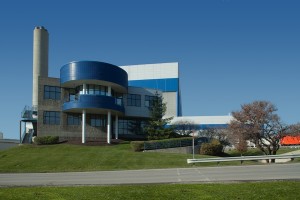
 Just south of downtown Indianapolis, tucked off of South Harding Street is a bright blue building quietly turning trash into energy. The Indianapolis Covanta facility is Indiana’s first and only Energy-from-Waste (EfW) facility and is not only producing enough energy to power 50 percent of downtown but is also complementing the process by recycling thousands of tons of metals.
Recently, I was fortunate enough to take a tour of the facility and see for myself exactly how efficient Covanta is and how it differs from landfills. Guided by Brian Foster, an Environmental Manager; James Regan another manager; and Meg Morris, Vice President of Covanta Corporate I was able to see first hand the journey trash takes in becoming energy.
Tipping/Bunker Area
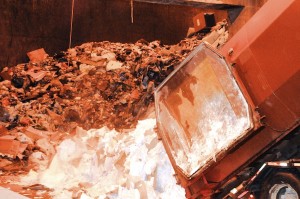
Tipping/bunker area
My journey began exactly where the Energy-from-Waste process begins — in the tipping and bunker area. Here trucks from Marion County and surrounding areas unload enormous cargos into what looks like a giant chamber known as the tipping area. A little further in and the tipping area turns into a large pit, or bunker, where the waste is stored until being moved to the combustion chambers. I know what you’re thinking — it probably smells awful in there. But it’s actually not bad! Covanta uses a process called negative pressure to contain the smell and prevent it from leaching outside of the tipping/bunker area. Essentially, a vacuum-type pressure sucks air out of the area and directs it into the combustion chambers to fuel the fires. Out on South Harding Street you don’t smell a thing!
The Claw
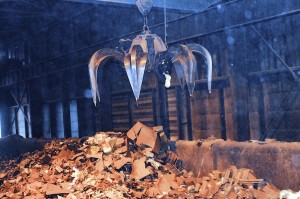
The Claw
While still in the tipping/bunker area, the next step in the Energy-from-Waste process is what Brian affectionately refers to as “The Claw.” A giant claw descends into the bunker and does one of two things: it either churns the waste to ensure a uniform mixture is fed to the combustion chamber or it picks up a mound of waste to add to said combustion chamber. Either way, watching the massive claw in action is exactly like being a kid and watching the claw game. Only this time, what you’re grabbing for doesn’t slip through.
Combustion Chamber
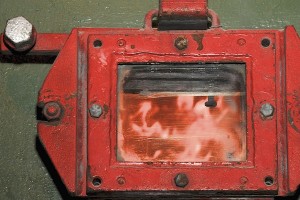
Combustion chamber
After being ensnared by the claw, the waste is fed into hoppers and slowly pushed down into the combustion chamber. Now, generally speaking, burning garbage is horrible for the environment. Brian and James made sure to emphasize the distinction between burning waste in an incinerator and Covanta’s innovative combustion chambers, which require no fuel (other than garbage) to sustain the flames.
Maintaining high temperatures in the combustion chamber, the hot gases created from the burning waste is guided to a series of boilers to produce steam. The steam in turn drives turbine generators to create energy. Some of that energy is used to power the Covanta facility while the rest of it is sold to Citizen’s Thermal Energy and distributed to the Indianapolis downtown steam loop. (Covanta powers almost all of the downtown businesses!)
Pollution Control
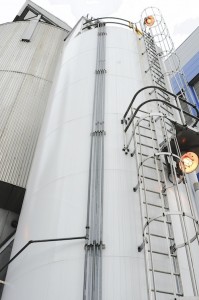
Pollution control
Unfortunately, a by-product of fires and steam is emissions. During the tour Meg noted that EfW facilities often receive criticism for creating emissions. But, she pointed out; emissions from EfW facilities are generally less polluted than emissions from landfills. Emissions from EfW facilities are funneled into highly controlled stacks where toxins and particulate matter are removed before the air is released. Whereas landfills secrete emissions into the air without any form of monitoring and may contain over 44 different toxins. Covanta works diligently to minimize any harmful pollutant from its emissions before it’s released. For instance, to extract mercury, activated carbon is injected into the stacks where it attracts and neutralizes the mercury molecules. Additionally, fabric filters strain out particulate matter before releasing anything into the environment. Currently, the Indianapolis Covanta facility operates between 60 and 90 percent better than permitted emission limits.
Material Recovery
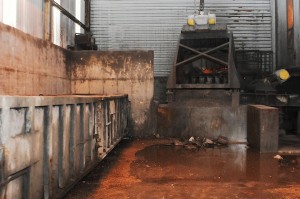
Material recovery
There are some things just won’t burn. And it’s a good thing too—because they’re recyclable! Metals generally don’t melt or burn at the temperatures in the combustion chambers and can be seen poking out of the ash. Covanta, like nose-to-tail eaters, is determined to use all parts of the waste. So they separate ferrous metals from the ash using magnets and the non-ferrous metals with eddy current separators. Eddy current separators use a reverse magnetic force to eject non-ferrous metals off the conveyer belt and into a containment area. I unfortunately didn’t get to witness any non-ferrous metals flying off into the containment area but I did get to see chunks of cement (an unrecyclable substance that won’t burn either) clunk down off the conveyor belt. What does end up in the containment area though is taken to recycling facilities where they can be reused to their fullest potential.
Ash Pit
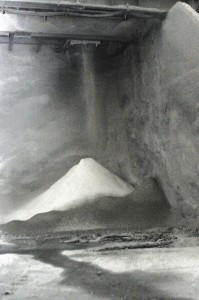
Ash pit
The last part of my tour, and subsequently the last stage for the waste, was the ash pit. A large, echoing room a single stream of ash pours down like sand through an hourglass. From here, the ash is either used beneficially or taken to a landfill. To be used beneficially means the ash is reused in manufacturing construction materials, such as mixing it in with concrete to make it stronger and more durable. By the time the ash reaches this point, it is not only one-tenth of its original size but has also been harvested for all potential energy.
Unfortunately, my tour ended too soon and I was back out on South Harding Street heading towards downtown. As I headed north, I passed all the other industrial facilities located in the area and I couldn’t help but wonder how efficiently they were running and whether or not their smokestacks monitored for mercury emission. I don’t know for certain their efficiency or pollutant rate but I will say this: they definitely smelled.
Indianapolis Covanta Facility Facts
- Indianapolis facility opened in December 1988.
- Accepts and processes over 2,175 tons of waste per day generating nearly 9 million pounds of steam!
- 16,000 tons of ferrous metal and 1,100 tons of non-ferrous metals a year.
- Saves 26,286 kilowatts of power a year.
- Powers most of downtown Indianapolis in addition to Indiana University, Purdue University Indianapolis campus, and Eli Lilly.
- 1 ton of waste will produce 550 kilowatts of power—which is enough to power a standard household for 2 weeks!
- 100 cubic feet of waste can be reduced to a 10 cubic feet pile of ash.